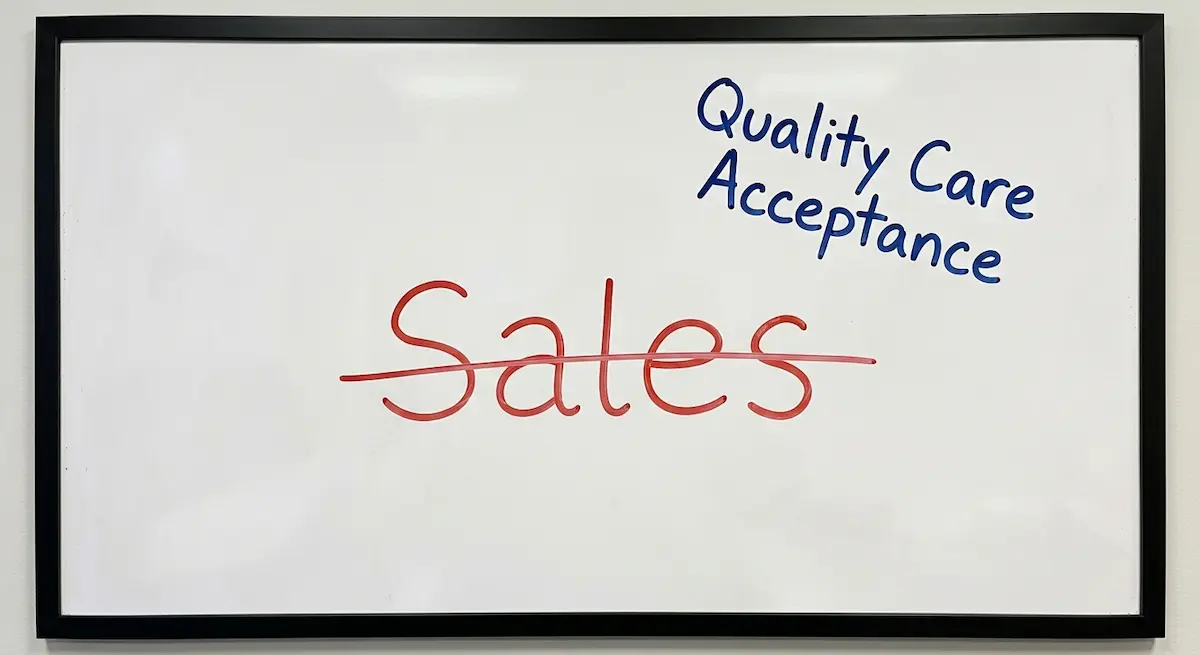
Early in my career as a practice owner, I avoided money conversations like the plague. I’d focus entirely on the medicine, deliver my recommendations, then disappear to the back while the front desk presented the invoice. I’d anxiously listen from afar, hoping clients would accept the plan without pushback. Sometimes they did. Other times, they asked for records to be transferred or argued about the bill in the lobby. Those moments were painful, and my discomfort only made the problem worse.
What I eventually realized was that mastering Patient Care Plan (PCP) acceptance is one of the most important skills in veterinary practice. It’s not about “selling” in the sleazy sense — it’s about respectfully helping clients understand and choose the care their pets truly need, while keeping the practice sustainable.
What “Sales” Really Means in Veterinary Medicine
The word “sales” often carries a negative vibe, but its root meaning is simply “to give or to help.” In the context of a Patient Care Plan, we’re not pushing products — we’re offering genuine help to both the pet and the owner through clear, trusting communication.
Building a Strong Patient Care Plan (PCP)
A solid PCP starts with a clear Tentative Diagnosis (TDx) — a straightforward statement of what’s likely wrong with the patient. From there, outline the recommended diagnostic and treatment steps. The most powerful question to ask yourself is: “What would I do if this were my own pet?” Believing in the plan is essential. If you’re not confident in it (especially as a newer veterinarian still building experience), clients will sense that hesitation and acceptance rates will drop.
The Best Place to Present the PCP: In the Exam Room
One of the biggest mistakes is presenting estimates over the phone or delegating complex financial discussions to junior staff. The front desk’s job is to welcome clients and facilitate flow — not to explain detailed medical plans. The most effective approach is to create and introduce the PCP right in the exam room. This allows you to address questions and objections privately and compassionately. Once the client shows initial understanding and agreement, a well-trained team member can then walk through the financial details. This keeps the veterinarian moving efficiently to the next patient while protecting the relationship.
Handling Objections with Confidence and Kindness
Clients push back for a few common reasons: they don’t fully understand the plan, they’re worried about cost, or they’re not the primary decision-maker. The golden rule is simple: Price becomes important in the absence of understanding.
- Use plain, everyday language. Avoid heavy medical jargon unless the client is medically trained.
- Incorporate simple visual aids — diagrams, drawings, or models — to create those important “lightbulb” moments.
- Present the plan slowly and check for understanding along the way.
Good, Better, or Best — Offering Flexible Options
Not every client can afford the ideal “best” plan. Having tiered options allows you to still deliver meaningful care. For example, a student brought in his cat with a painful abscess and fever. The full hospitalization plan was $688, which he couldn’t manage. We shifted to a “good” option — lancing the abscess, placing a drain, and prescribing antibiotics — for $125. The cat improved, and the practice remained viable.
In more serious cases where downshifting isn’t safe, gently explore financial solutions in private. One client initially wanted to euthanize her Pekingese after it was hit by a car because of cost. After a compassionate, private conversation about payment options (including using a credit card she had “for emergencies”), she chose to proceed with treatment. The dog recovered beautifully, and she later returned with flowers to thank the team.
Bridging the Understanding Gap
Sometimes clients walk away from excellent care simply because the value wasn’t clearly explained. A wealthy couple once left a high-quality AAHA practice after hearing a $1,200 dental quote over the phone and chose a $125 procedure elsewhere — leading to complications. A calm, in-person conversation with visuals could have made all the difference.
Action Steps for Better PCP Acceptance
- Always present the Tentative Diagnosis and PCP in the exam room — never over the phone.
- Use clear, empathetic, jargon-free language.
- Build every plan as if it were for your own pet.
- Go slowly and confirm understanding at each step (“What’s your understanding of this plan so far?”).
- Use simple visual aids to make concepts clear.
- Ask for agreement: “Would you agree this is the best path for your pet?”
- Present the invoice line by line with a trained team member.
- Handle objections kindly but confidently — don’t abandon a good plan at the first pushback.
- Offer Good / Better / Best options when appropriate.
- Privately explore respectful financial solutions when clients are struggling.
Mastering these conversations transforms “sales” from something uncomfortable into a genuine act of service. When clients truly understand the value of the care you’re recommending, acceptance rates improve, patients get better outcomes, and your practice stays healthy.
If you’re still dreading the financial part of appointments or seeing too many good care plans declined, you’re not alone. Many practice owners face this challenge.
Ready to improve client acceptance and reduce financial stress in your practice? Schedule a free 30-minute Practice Potential Analysis call. Let’s work on practical strategies that fit your style and your team.
Practice Potential Analysis – Schedule Here
What’s been your biggest challenge when presenting Patient Care Plans? Do you present in the exam room or delegate it? Share your experiences in the comments — I’d love to hear what’s working (or not working) in your practice.